Platform comparison
| Platform | YES odds | NO odds | Fee | KYC | Settlement | |
|---|---|---|---|---|---|---|
Polymarket (via Who Will Win) Pick polygram.ink (preferred broker) |
25% | 75% | 0% (USDC on-chain) | No-KYC up to $1,500 | USDC, auto via UMA oracle | Live odds → |
Polymarket (direct) polymarket.com |
25% | 75% | 0% | Geo-blocked in US/UK/EU | USDC, on-chain | Live odds → |
Kalshi kalshi.com |
— | — | Up to 7% per trade | US-only, KYC required | USD | Live odds → |
Betfair Exchange betfair.com |
— | — | 2-5% commission | Full KYC from first trade | GBP / EUR | Live odds → |
Manifold Markets manifold.markets |
— | — | Play-money (mana) | None — play-money | Mana (no cash-out) | Live odds → |
Outcome probabilities
Current market-implied probability for each outcome, from the live order book.
| Outcome | Probability |
|---|---|
| Somaliland | 25% |
| Qatar | 12% |
| Syria | 12% |
| Jordan | 10% |
| Kuwait | 10% |
| Lebanon | 10% |
| Turkey | 9% |
| Saudi Arabia | 9% |
| Egypt | 8% |
| Azerbaijan | 7% |
| Pakistan | 6% |
| Oman | 5% |
Market context
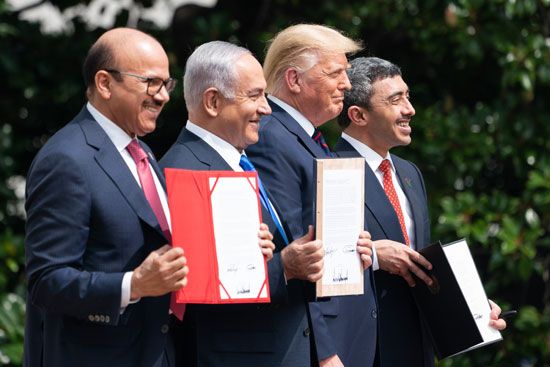
Kazakhstan’s move showed that the Abraham Accords can still expand through a low-drama, symbolic signing, but it also underlined how selective the pipeline is: the bloc has grown only when the diplomatic cost is manageable and the security picture is not too toxic.[8][5] With this market at a 6% crowd-implied probability, the consensus is firmly that a new entrant before end-2026 is a long shot, so the favourite side is still *No* and any *Yes* case needs a specific, official breakthrough rather than broad regional mood music.[1]
For framing, the comparable cases point to a market that usually overweights headline diplomacy and underweights execution risk. Saudi Arabia remains the classic high-upside underdog: strategically important, but far harder to close than smaller or more transactional cases, especially while Gaza remains unresolved and regional tensions stay elevated.[7][5] That leaves value more likely on contrarian *Yes* names that could plausibly sign with limited domestic political cost, rather than on the marquee candidates that attract attention without concrete movement.[1][3]
The main catalysts to watch are formal announcements from Israel and the target government, any US-brokered summit or trilateral statement, and whether the country is already on a public path to normalisation through separate diplomatic talks. Kazakhstan’s accession is a reminder that a deal can surface quickly when an administration wants to showcase foreign-policy progress, but the market will only resolve on an official, publicly acknowledged signing tied to the Accords framework.[8][1] Traders should also watch for unexpected movement in countries already mentioned in the market flow, where fresh reporting or a leadership visit could reprice the long tail fast.[2][3]
Methodology
We track Which country will join Abraham Accords before 2027? across the five venues with material prediction-market liquidity. The probability shown is the live Polymarket mid; the comparison rows summarise how each venue treats the underlying contract — fees, KYC thresholds, settlement currency, deposit options. The highlighted row marks the cheapest route into Polymarket's order book.
Resolution & payout
At resolution the UMA oracle takes over: a proposer posts the outcome with a bond, any token holder can dispute within two hours. Without dispute the result is accepted and the smart contract distributes USDC instantly.
On Kalshi (CFTC-regulated) resolution runs through their in-house clearing engine in USD. Betfair Exchange settles after match end in the account's local currency. Manifold pays no cash — only its in-platform "mana" currency.
FAQ
- How does resolution work?
- Through the UMA Optimistic Oracle on Polygon: a proposer submits the outcome, a two-hour challenge window opens, and USDC payouts settle automatically once the result is final.
- What's the difference between YES and NO shares?
- A YES share pays $1.00 if the event happens, $0 otherwise. A NO share pays $1.00 if the event doesn't happen. The market price between 0¢ and 100¢ is the implied probability.
- What does Polymarket cost to trade?
- Polymarket itself charges 0% — the only cost is the Polygon network fee, typically under $0.01 per transaction. Off-chain venues like Kalshi or Betfair charge 2-7% commission.
- How fast are USDC deposits?
- Polygon credits deposits after 12 confirmations — usually under 30 seconds. Withdrawals follow the same path and land back in your wallet within minutes.
- How reliable are the quoted odds?
- The YES/NO percentages are the live mid-prices of the Polymarket order book. On deep markets they move every few seconds; on thinner ones you'll see short plateaus.
%22%2F%3E%3Cpath%20d%3D%22M%206%2066%20A%2026%2026%200%200%201%2058%2066%22%20fill%3D%22%23E6B98D%22%20opacity%3D%220.9%22%2F%3E%3Ccircle%20cx%3D%2232%22%20cy%3D%2226%22%20r%3D%2222%22%20fill%3D%22%23F5CBA7%22%2F%3E%3Crect%20x%3D%2214%22%20y%3D%224%22%20width%3D%2236%22%20height%3D%228%22%20rx%3D%224%22%20fill%3D%22%23facc15%22%2F%3E%3C%2Fsvg%3E) and
and%22%2F%3E%3Cpath%20d%3D%22M%206%2066%20A%2026%2026%200%200%201%2058%2066%22%20fill%3D%22%23E6B98D%22%20opacity%3D%220.9%22%2F%3E%3Ccircle%20cx%3D%2232%22%20cy%3D%2226%22%20r%3D%2222%22%20fill%3D%22%23F5CBA7%22%2F%3E%3Crect%20x%3D%2210%22%20y%3D%224%22%20width%3D%2244%22%20height%3D%2214%22%20rx%3D%227%22%20fill%3D%22%23facc15%22%20opacity%3D%220.9%22%2F%3E%3Crect%20x%3D%228%22%20%20y%3D%2218%22%20width%3D%228%22%20%20height%3D%2218%22%20rx%3D%224%22%20fill%3D%22%23facc15%22%20opacity%3D%220.7%22%2F%3E%3Crect%20x%3D%2248%22%20y%3D%2218%22%20width%3D%228%22%20%20height%3D%2218%22%20rx%3D%224%22%20fill%3D%22%23facc15%22%20opacity%3D%220.7%22%2F%3E%3C%2Fsvg%3E)
Trade Which country will join Abraham Accords before 2027? on Who Will Win
Live order book, 0% fees, USDC settlement in seconds.
Open live market →